
Same Slot, Different RTP: How to Check Which Version You Are Playing
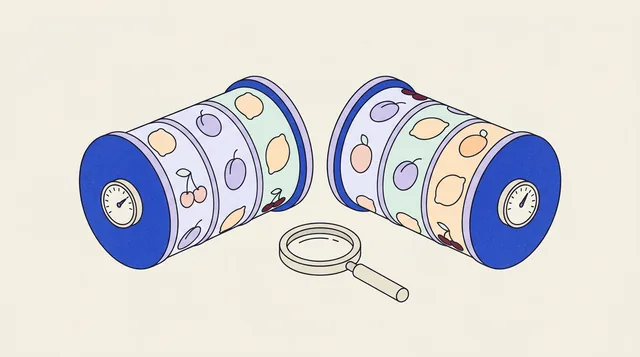
A slot's return-to-player figure is not always a fixed property of the title. Some game studios publish several certified percentages for one game, and the version you open depends on the casino's configuration. In this guide we explain how that works, where the information screen shows the number, what regulators say about disclosure, and what a few points of RTP cost over real turnover.
On this page
19+18+ in Alberta, Manitoba and QuebecGambling problem? ConnexOntario, free and confidential 24/7: 1-866-531-2600Set limits before you play
One title, several published percentages
Return to player is the share of wagered money a game is designed to pay back over a very long run. Most players learn it as a single number printed in a review. For some studios that picture is incomplete. Hacksaw Gaming's page for Rip City, for example, lists four RTP values in its game data: 96.22%, 94.27%, 92.32% and 88.02%. Its page for Blocks lists six: 98.00%, 97.00%, 96.00%, 94.00%, 92.00% and 88.00%. The pages do not explain who chooses between the values or which one applies where.
That gap is worth being honest about. We found no studio page that spells out the selection process, so what follows about operator choice is our inference from the published lists and from the way regulators describe game approval. The lists themselves are facts on the studio's own site; the mechanism behind them is the part to confirm in the game you are about to play. Reviews and directories that quote one number for a title are therefore describing, at best, one of several builds, and they rarely say which. The practical consequence does not depend on the mechanism: two casinos can offer a game with the same name, art and features, yet run a different percentage.
What a few points of RTP cost
The gap sounds small until it is multiplied by turnover. The table below is a worked example using the four Rip City values as pure arithmetic. It assumes C$10,000 of total wagers, which is what a C$1 spin repeated 10,000 times produces, and it shows the long-run expected loss, not what any single session will do.
| RTP | House edge | Expected loss per C$10,000 |
|---|---|---|
| 96.22% | 3.78% | C$378 |
| 94.27% | 5.73% | C$573 |
| 92.32% | 7.68% | C$768 |
| 88.02% | 11.98% | C$1,198 |
The lowest version costs about C$820 more than the highest on identical turnover, roughly three times as much expected loss. Nothing about the reels or the bonus round looks different. This is also why chasing a game's reputation is weak evidence: a title praised for generous returns can still be the 88% build on the site where you happen to open it. For the betting side of the same arithmetic, our guide to how real-money slots actually pay walks through variance and bankroll sizing.
RTP is a long-run average, not a forecast
The UK Gambling Commission's guidance on live RTP monitoring gives a clear sense of how loose the link is over short samples. It defines theoretical RTP as the designed return to player percentage and says it is also the advertised figure shown in player-facing rules. It then notes that the tolerance is wider when only a limited amount of play has been measured, and that after a significant amount of play the actual RTP should be very close to the theoretical figure. In its illustration, a game designed at 91.68% could return anywhere from 89.93% to 93.43% over 400,000 plays and still be performing as expected.
If a regulator's own example allows a spread of about 3.5 percentage points across 400,000 plays, a single evening of play is dominated by luck. That cuts both ways. You cannot tell from a session whether the version is high or low, so the only reliable check is to read the number before you stake money. Volatility decides how bumpy the path to that average feels, and our slots hub is the place to start on it.
Where to find the figure inside the game
There is no universal location, but the same few places cover most games. Open the game, then look at these in turn:
- The information or help icon, often a small i or a question mark, usually reachable from the menu or the spin panel.
- The paytable or game rules section, where the rules of play are set out.
- The casino's own game information page, if it publishes one; compare the number with the in-game screen, and trust the screen if they differ.
Look for the words return to player, RTP or theoretical return. If the screen shows a range or several figures rather than one, we would treat the lowest as the working assumption until the game says which applies, a precaution of ours and not a rule. If the figure cannot be found at all, that is itself informative: in the UK, standard RTS 3C expects the RTP percentage to be easily available before the customer commits to gamble, and Ontario's Registrar's Standards require explanatory content on odds, payout odds or returns to players.
What the rules actually require
Disclosure rules exist, but they do not set a minimum RTP, and they do not say that one game must carry one figure everywhere. The AGCO's Registrar's Standards for Internet Gaming state that explanatory content must include comprehensive, accurate and understandable information on odds of winning, payout odds or returns to players (standard 4.06). Game specifications must document the odds of winning each prize and the operator's advantage on each wager (4.05). Any gaming system that determines outcomes must be approved or certified before deployment, including subsequent modifications (4.08), and records must track game enabling, disabling and configuration changes (4.02).
Read together, those clauses mean that an Ontario-registered operator cannot quietly swap a game's configuration without it passing through testing and records. They do not stop an operator from choosing one approved configuration over another. The standards also state that free-to-play games must have the same odds as the paid versions (2.15), so the demo should show the same RTP as the real-money game on that site. If a demo and the cash version disagree, ask support for the explanation. The Ontario standards do not address the same-game, different-operator question directly, which is why the in-game screen matters more than any directory.
A simple worked comparison shows why the decimals matter. Using the Rip City values above, the gap between 96.22% and 94.27% is 1.95 percentage points. On C$2,000 of total wagers that is C$39 of extra expected loss, and on C$20,000 it is C$390. A figure rounded to about 96% would hide that difference entirely, which is why we record the exact number, with its decimals, whenever we compare two sites.
A routine before you deposit
You need about two minutes per game, and the sequence below makes the check repeatable.
- Open the game in demo mode and find the RTP line in the info screen.
- Note the exact figure with its decimals; 96.22% and 96.0% are different builds.
- Open the same game on the second site you are considering and compare the figures side by side.
- Write the lower of the two in your own notes, with the date you checked.
- If the studio's page publishes a list, check that the figure you saw appears in it.
This matters most when a game is part of a promotion, because wagering requirements amplify the cost of a lower build; our piece on wagering requirement maths turns the same arithmetic into bonus terms. Features that are sold directly carry their own RTP too, which we cover in the guide to bonus buy in slots. For choosing among studios, our game software page lists who builds what.
Finally, treat RTP as one input to a decision about how much you want to play, not a reason to play more. If spending stops feeling like entertainment, ConnexOntario offers free, confidential support at 1-866-531-2600, and each province has its own line.
Frequently asked questions
Can the same slot have different RTP at different casinos?
Yes, in principle. Some studios publish several RTP values for one title; Hacksaw Gaming lists four for Rip City, from 96.22% down to 88.02%. Which figure a given casino runs is shown in that casino's game information screen, so check it per site.
Where is the RTP shown in a slot?
Usually in the information, help or paytable screen reached from the game menu. Look for the words return to player, RTP or theoretical return, and note the figure to two decimals. If you cannot find it, ask the casino's support before depositing.
Does a higher RTP mean I will win more in a session?
No. RTP is a long-run average across very large numbers of plays. The UK Gambling Commission's illustration shows a game designed at 91.68% could return 89.93% to 93.43% over 400,000 plays and still be working as expected.
Do Canadian regulators set a minimum RTP for slots?
Ontario's Registrar's Standards for Internet Gaming do not set a specific RTP or payout percentage. They require clear information on odds, payout odds or returns, approval of game systems, and records of configuration changes.
Sources
More from the blog
 RegulationKahnawake Gaming Commission: Licences and ComplaintsWhat the Kahnawake Gaming Commission regulates, the permits it issues, how its complaint process works and how to check a licence before you deposit.
 Safer playSelf-Exclusion in Canada: Programs by ProvinceHow self-exclusion works in Ontario, BC, Alberta, Manitoba, Saskatchewan and Quebec: term lengths, how to enrol, what is blocked, and device-level blockers.
 TaxWhen the CRA Treats Gambling as Business IncomeHow Canadian tax law separates casual gambling from taxable business income, what the poker cases turned on, and which records are worth keeping either way.